

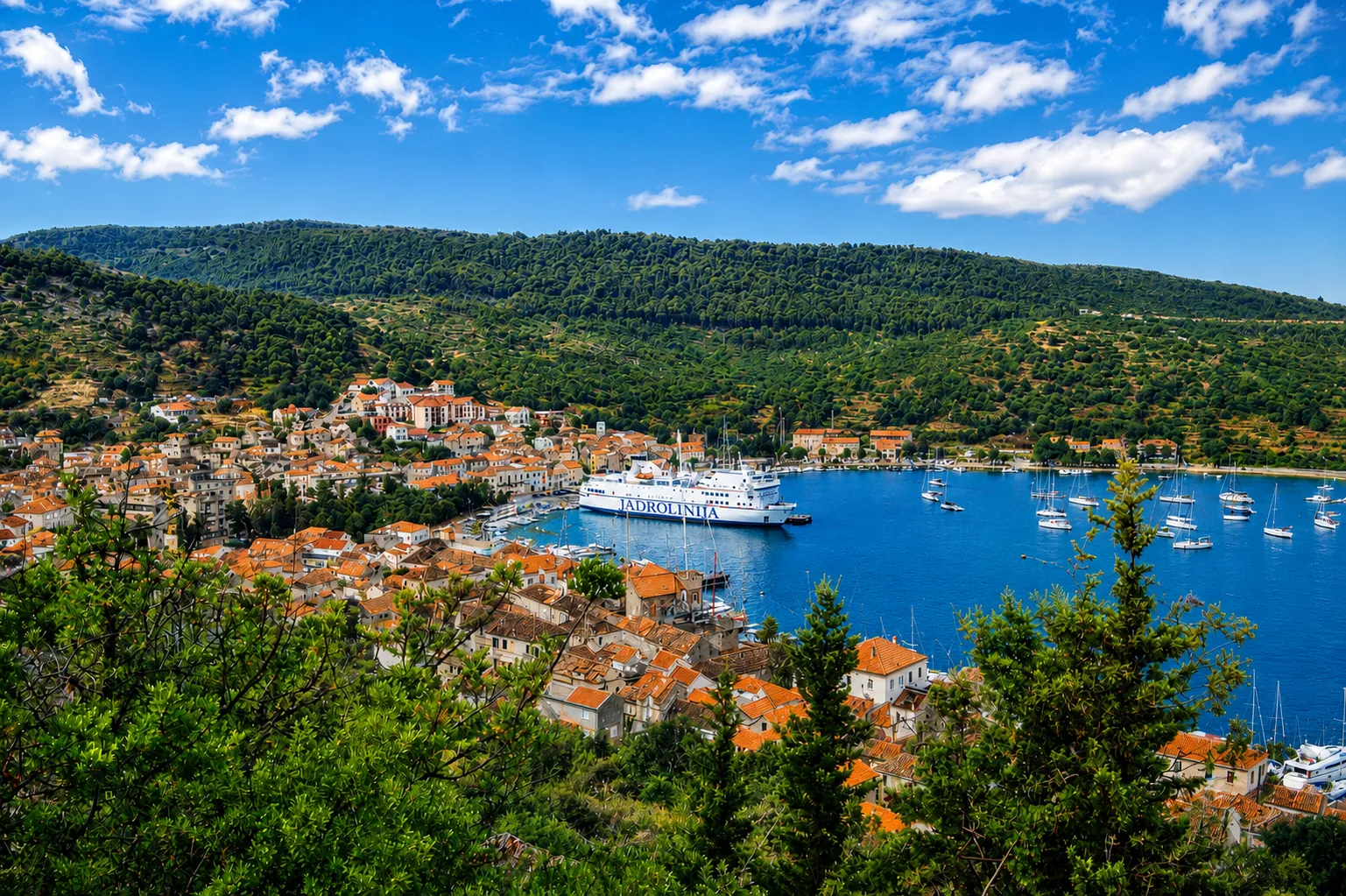
Planning a trip to Vis, the most remote inhabited island in Croatia? This ultimate guide cuts right through the confusion to help you navigate the busy port of Split, master ferry schedules, and safely reach your pristine island paradise today.
Interactive Map of Vis Island
Use this fully interactive map to trace your route from the Split Ferry Port, locate Vis Town and Komiža on opposite sides of the interior ridge road, and scope out the isolated bays scattered along the rugged southern coastline.
So, you’ve seen the photos of Stiniva Cove, you’re craving that sleepy, authentic Dalmatian vibe, and you’ve decided Vis is the place. Great choice. But here’s the catch—Vis isn’t Hvar. You can’t just hop on a water taxi every twenty minutes. It is the furthest inhabited island from the Croatian mainland, and because it spent decades locked down as a top-secret Yugoslav military naval base, it completely missed out on the massive wave of early commercial overdevelopment. That isolation is exactly why it’s so magical today, but it also means your transport logistics need to be watertight. If you don’t plan ahead, you’ll easily blow half a day sweating on a hot concrete pier in Split, watching your boat sail away while you’re stuck eating an overpriced sandwich.
Quick heads-up: Some of the links in this post are affiliate links. This means if you book a tour or secure a room through them, I earn a small commission at zero absolute extra cost to you. I only suggest things I genuinely trust, and your support keeps this site running!
Step 1: Getting to the Launchpad (Split)
Before you can even look at a ferry timetable, you need to get yourself to Split, the ultimate gateway to the middle Dalmatian islands.
If you are flying in, you’ll land at Split Airport (SPU). It’s a busy, efficient hub, and flights are absolutely packed out during the summer season. To grab the best flight deals without getting gouged by peak holiday pricing, use Aviasales to compare operators and lock down your route early.
Once your wheels touch the tarmac, the clock is ticking. The airport is actually located in Kaštela, about 25 kilometers away from the Split Ferry Port. Do not underestimate this journey. In the shoulder season, it’s a smooth 30-minute drive. In July or August? The coastal road turns into a giant, sun-baked parking lot. Give yourself at least an hour to an hour and a half to make this transfer. You can grab a local airport bus, haul a taxi, or pre-arrange a private ride if you want zero stress.
If your plan involves a wider Croatian road trip before or after hitting the island, you might want to pick up a vehicle right at the terminal. For comparing local independent suppliers and ensuring you don’t get stung by massive credit card deposits or hidden fees at the desk, DiscoverCars is your best bet for sorting out a reliable set of wheels. Just keep in mind that bringing a car to Vis changes the logistical equation entirely—something we are about to break down.
No matter how you arrive at the port, make sure you have solid travel medical insurance sorted before you leave home. Delayed flights, lost luggage, or missed ferry connections can throw a massive wrench in your island-hopping itinerary, so checking out comprehensive protection on VisitorsCoverage is a smart, common-sense move to keep your peace of mind intact.
The Split Ferry Port Layout: Don’t Get Lost
Once you arrive at the Split port, it can feel a bit chaotic. It’s one of the busiest transit ports in the Mediterranean, packed with massive international cruise liners, local fishing boats, and rows of island ferries all competing for dock space.
The main thing you need to know is that tickets are tied to specific operators. The two main players heading out to Vis are the state-run company Jadrolinija and the high-speed catamaran specialist Kapetan Luka – Krilo. Their physical ticket offices sit along the main harbor drive, but rocking up to buy a paper ticket on the day is a total rookie mistake, especially in peak season. You want to buy these online well in advance to secure your spot.
So, once you’re standing on the harbor with your digital ticket ready on your phone, what’s the best way to actually cross the water? You’ve got two distinct choices: the lumbering, ultra-reliable car ferry or the sleek, fast catamaran. Both have their pros and cons, and picking the wrong one can completely derail your travel day.
Let’s pit them against each other so you can decide which boat fits your travel style perfectly.
The Great Debate: Car Ferry vs. High-Speed Catamaran
Let’s talk about the big choice you have to make once you’re standing at the port: the slow-and-steady car ferry or the zip-across catamaran.
If you’re a foot passenger traveling light, the high-speed catamaran is a tempting option. Run by operators like Kapetan Luka – Krilo, these sleek passenger boats shave the travel time down to about 90 minutes. They drop you right into Vis Town, looking fresh and ready for a cold beer. The downside? You are locked inside an air-conditioned cabin for the whole journey. There’s no stepping out onto a breezy deck to watch the mainland fade away or to get that perfect shot of Hvar as you fly past. Also, if the sea gets choppy, these smaller catamarans bounce around like a cork in a washing machine, meaning sailings get cancelled way faster than the big ships.
Then you have the classic car ferry. This lumbering giant takes a leisurely 2 hours and 20 minutes to make the crossing. It might be slower, but it’s an absolute tank. It handles rough seas with ease, and best of all, it features massive outdoor decks. You can sit outside in the Mediterranean sun, feel the sea spray, and truly feel like your island holiday has started.
The Brutal Reality of Bringing a Car
Here is the golden rule that catches out thousands of drivers every single summer: buying a vehicle ferry ticket online does not reserve you a physical space on that specific boat. Read that twice. Your ticket gets you a ride on that day, but the actual boarding process is strictly first-come, first-served.
If you are traveling in July or August with a car, you need to park your vehicle in the designated boarding lanes at Split Harbor at least two hours before departure—sometimes even earlier for the morning sailings. If you roll up 20 minutes before the horn blows, you will be left standing on the hot asphalt watching the ferry doors close, wishing you’d skipped that extra cup of coffee.
Because taking a car across can be a costly, stressful headache, many smart travellers choose to leave the car on the mainland or ditch the rental entirely before heading over. Vis is a small island with two main towns connected by a brilliant, scenic ridge road. Instead of dragging a massive family car onto the ferry, a far better option is to head over as a foot passenger and rent a nimble scooter or a rugged e-bike once you arrive. You can easily book a set of two wheels in advance using BikesBooking.com, which lets you bypass the car ferry queues entirely and zip around the island’s narrow, winding lanes with absolute ease.
Whichever option you choose, make sure you have your island base locked down well before you step on board. Vis has a strict cap on mega-hotels, meaning accommodation is mostly made up of charming stone apartments and family-run villas that sell out months in advance. To snag a spot close to the harbor in Vis Town or down by the fishing port in Komiža, browse through Booking.com early to secure a place before the summer rush leaves you stranded.
Now that you know how to handle the boat options, let’s talk about what happens when you finally touch down on the island and need to get from the ferry dock to your accommodation.
Stepping Off the Boat: Welcome to Vis Town
The second the ferry ramp drops or you step off the catamaran, you’re in Vis Town (Luka Vis). It’s a gorgeous, horseshoe-shaped bay lined with crumbling stone palazzi, family-run konobas, and palm trees. If you’ve booked an apartment right here in the main hub, congratulations—you can probably roll your bags to it in about ten minutes.
But a lot of travellers prefer to base themselves on the exact opposite side of the island in Komiža, a postcard-perfect fishing village tucked under the shadow of Mount Hum. It’s about 10 kilometers away across the interior ridge. If you don’t have a car or a scooter waiting for you on the pier, you need to navigate the local island transit system immediately.
The Synced Island Bus System
Here’s a bit of excellent news: the island’s public bus system is brilliant, purely because it is completely synchronized with the boat arrivals. Whenever a car ferry or catamaran pulls into Vis Town, there will be one or two orange buses idling right outside the terminal gates.
Don’t panic about trying to book this online in advance. You just climb aboard, buy a ticket directly from the driver (keep some euro cash handy, though contactless cards are standard now in 2026), and enjoy the ride. The bus climbs up the old mountain road, giving you some absolutely stunning panoramic views of the Adriatic, before dropping you down into the center of Komiža about 15 to 20 minutes later.
The big catch? That bus leaves shortly after the boat unloads. If you dawdle, stop to take ten photos of the harbor, or get stuck waiting for a slow bag in the belly of the ship, you will miss it. Once that bus pulls away, it won’t return until the next scheduled boat arrives hours later.
Heavy Bags and Tight Timelines
If you’re travelling with a heap of heavy luggage, have young kids in tow, or simply don’t want to play the “rush to the bus” game, look into a private transfer. Taxis hang around the port, but they know they have a captive audience and peak-season pricing can get a bit wild. Pre-booking a personal ride via Welcome Pickups means you’ll have a professional local driver waiting for you right at the pier, ready to toss your bags in the trunk and cruise over the ridge without any haggling.
Another classic logistical headache is the awkward check-in gap. If you catch an early morning ferry from Split, you’ll land on Vis around midday, but your host might not have the apartment ready until 3:00 PM. Dragging rolling suitcases over historic, bumpy cobblestones while hunting for lunch is an absolute nightmare. Instead of babysitting your bags at a cafe, use Radical Storage to find a secure, verified local shop or agency to drop your gear for a few hours. It lets you explore the town, grab a proper seafood lunch, and start enjoying the island hands-free.
Locking In Your First Big Excursion
Once you’ve safely dropped your bags at your base, your very first logistical priority should be scoping out the weather for the iconic Blue Cave (Modra Špilja) on the tiny neighboring island of Biševo. It is easily the most famous day trip from Vis, but it is entirely dependent on sea conditions. If the wind picks up even slightly from the south, the tiny cave entrance submerges and the whole site locks down.
Because everyone wants to see it, the queues at the Komiža harbor can get crazy by midday. Your best move is to check out small-group boat excursions on GetYourGuide ahead of time. Booking a morning slot with a reliable local skipper ensures you get out there before the sea gets too choppy or the massive tour boats from Split and Hvar arrive to clog up the waters.
Cracking the Island Code: Getting to the Secret Spots
Alright, you’ve made it across the Adriatic, dropped your bags, and successfully avoided losing your luggage. Now comes the fun part: actually getting out to the spots that made you book this trip in the first place. Vis isn’t a massive island, but its topography is no joke. It’s essentially a series of jagged limestone ridges dropping steeply into the sea, cut through by two main roads—the fast new road along the north coast and the winding, scenic old road through the interior vineyards.
If you want to see the real Vis, you have to accept that the best spots require a bit of logistical effort. Take Stiniva Cove, for example. You’ve definitely seen the pictures of this spectacular hidden beach, squeezed between two towering cliffs that almost meet in the middle. What those pictures don’t show you is the brutal, sun-baked goat track you have to hike down to reach it. It’s a steep, slippery, 20-minute scramble over loose gravel. Do not be that tourist who tries to tackle this descent in cheap flip-flops while carrying an inflatable flamingo and a cooler box. Wear proper trainers, take your time, and pack light. If the hike sounds like a nightmare, you can hire a local taxi boat from the nearby bay of Rukavac to drop you right at the cliff opening.
The Secrets of the Underground Military Tunnels
Because Vis was a locked-down naval base until 1989, the entire island is hollowed out like a Swiss cheese with secret underground tunnels, hidden missile silos, and submarine pens. It’s wild. You can literally walk right into a massive concrete submarine hideout cut deep into the rock at Jastog or explore the labyrinth of cold war bunkers at Vela Glava.
While you can technically hunt down some of these spots on your own, a lot of them are entirely unmarked, hidden down rough dirt tracks, and pitch black once you step inside. To get the actual history and avoid wandering into unsafe, decaying military structures, booking a rugged 4×4 open-top jeep tour through Viator is the absolute business. A local guide will take you tearing through the inland brush, unlock the gated command bunkers, and tell you the crazy stories of what went on here when the island was completely cut off from the rest of the world.
Staying Connected in the Wilderness
Here’s a quick tech warning for you: when you are wandering around the south coast or deep inside an iron-reinforced Yugoslav bunker, your mobile signal is going to take a serious hit. There is nothing worse than trying to navigate a dirt track to find a hidden bay like Pritišćina, only to realize your phone maps have completely frozen.
Before you even step foot on the ferry in Split, make sure your data situation is sorted. Dropping a local eSIM onto your phone via Airalo takes about two minutes and gives you instant access to reliable local networks across the island. Download your regional maps for offline use before you head out into the hills, and you won’t have to worry about getting lost in the middle of a Dalmatian vineyard with zero bars.
Now that we’ve sorted the logistics of getting to the island, moving your gear, and tracking down the best secret adventures, let’s tie everything together into a bulletproof checklist so you can execute this trip like a pro.
The Bulletproof Vis Logistics Checklist
Here we are at the finish line. You’ve got the insider knowledge, you know how to handle the boats, and you know how to avoid the classic tourist traps. To make sure nothing slips through the cracks while you’re packing your bags, here is your definitive, no-nonsense master checklist for reaching Vis without a single headache.
- Book Your Ferry Early (The Ultimate Rule): The second your travel dates are locked down, get on the official Jadrolinija website and secure your passenger or vehicle tickets. Do not wait until you arrive in Split.
- Double-Check Your Mainland Wheels: If you are planning a massive coastal drive before heading over to the island, compare rates across multiple aggregators. If your primary choices are sold out, run a quick search on Economybookings.com to find competitive backup car hire quotes right out of Split Airport.
- Compare Accommodation Rates: Vis fills up incredibly fast because it lacks giant concrete mega-resorts. If you want to double-check that you are getting the absolute best price on that stone apartment in Komiža, cross-reference your options on Agoda to catch any hidden mobile-only discounts before locking it in.
- Lock Down Your Digital Privacy: You’ll be spending a fair bit of time hanging around the Split Ferry Port or sitting in island cafes checking maps. Public networks are a playground for data snoopers, so make sure you fire up NordVPN before connecting to any open Wi-Fi to keep your banking apps and personal passwords totally locked down.
- Keep Euro Cash Handy: While Croatia is fully integrated into the Eurozone and digital payments are everywhere, small island taxi boats, beach fruit stands, and the local Komiža bus drivers still appreciate crisp banknotes. Grab some cash from a mainland ATM before you board.
- The 2-Hour Lane Rule: If you absolutely must bring a car to the island during July or August, park your vehicle in the ferry boarding lane at least two hours before the departure time. If you’re a foot passenger on a catamaran, rocking up 30 minutes before is plenty.
Final Thoughts: Is Vis Worth the Effort?
When you’re sitting on a delayed bus in Split or waiting in a hot ferry queue, you might wonder if a remote island is worth all this logistical gymnastics. But the exact moment that massive ferry clears the tip of Hvar and the rugged, green cliffs of Vis rise out of the deep blue Adriatic, all that stress completely melts away.
You’re stepping into a place where life moves slower, the seafood is caught fresh every morning, and the water is so clear it looks like glass. By handling the boring logistics like a pro ahead of time, you ensure that the only thing you have to worry about when you land is deciding which beachfront konoba to hit first for a cold drink.
Pack your bags, sort your tickets, and get ready for an absolute classic of a trip.