Planning a legendary trip down the wild French Atlantic Coast is brilliant, until you try figuring out the local trains and car rentals. Do not get stuck. This practical guide shows you how to conquer the main transport hubs easily.
What’s Inside This Guide
- 1. Mastering the Northern Gateway: Nantes Atlantique
- 2. The Rail Network and Breaking Free from the Tracks
- 3. The Mid-Coast Conundrum: La Rochelle and the Island Escape
- 4. The Southern Powerhouse: Bordeaux and the Silver Coast
- 5. The Southern Finale: Biarritz and the Basque Country
- 6. The Golden Checklist: Nailing Your Digital Security and Safety Net
Interactive Transit Hub Map: French Atlantic Coast
Use this fully interactive map to explore the key coastal gateways, rail hubs, and island escape routes covered in this guide. You can pan, zoom, and track the entire route from the northern launchpad of Nantes all the way down to the Spanish border past Biarritz.
How to Navigate the Transport Hubs of the French Atlantic Coast
Planning a road trip or an island-hopping holiday down the wild, salt-whipped French Atlantic Coast is an absolute dream, right up until you actually look at the transit map. This stunning coastline stretches all the way from the rugged shores of Brittany down to the border of Spain. If you try to wing it without knowing how the local trains, regional airports, and car rental networks link up, you are going to end up stranded on a provincial platform or paying €120 (roughly $130 USD) for a last-minute airport cab.
Mastering the Northern Gateway: Nantes Atlantique
Let’s start in the north with Nantes. While it sits slightly inland on the Loire River, it serves as the massive logistical launchpad for the upper half of the Atlantic Coast. If you are flying in from abroad, you’ll likely land at Nantes Atlantique Airport (NTE). It’s a busy, compact single-terminal hub that can get incredibly chaotic during the peak summer months.
When hunting down the best flight options into Nantes, don’t just rely on standard legacy airline searches. Using a platform like Kiwi.com is a game-changer here because its virtual interlining tools allow you to stitch together connecting budget flights that other platforms completely ignore.
Once your wheels touch the tarmac, you face the classic airport escape problem. The official airport shuttle bus (the Navette Aéroport) departs every 20 minutes and costs €10 (about $11 USD) per person, dropping you directly at the central train station. It’s cheap, but if you are traveling with a family, heavy luggage, or landing late at night, wrestling for standing room on a packed bus is a miserable way to start a holiday. Instead, skipping the stressful taxi queues by pre-booking a private transfer with Welcome Pickups is a no-brainer. A local driver will meet you right at the arrivals gate, handle your bags, and get you to your accommodation or the train station completely stress-free for a flat, transparent rate.
The Rail Network and Breaking Free from the Tracks
If you arrive by train, you’ll pull into Gare de Nantes. The French high-speed TGV trains run effortlessly from Paris Montparnasse to Nantes in just 2 hours, flying through the countryside at speeds of up to 320 km/h (around 200 mph). You can check routes and timetables directly on the official SNCF Connect portal. The station is split into North and South terminals connected by a massive pedestrian bridge—if you need the local tramway network operated by Naolib to reach a city center hotel, follow the signs for the North exit.
From Gare de Nantes, local regional trains (TER) branch out directly to coastal hotspots like Pornic, Saint-Gilles-Croix-de-Vie, and Les Sables-d’Olonne. But here is the hard truth about the French Atlantic Coast: while the trains are brilliant for jumping between major cities, they completely miss the best hidden beaches, oyster shacks, and wild cliffs of the Vendée region.
To truly explore on your own terms, you need a car. Whatever you do, do not roll up to a rental desk at Nantes station without a reservation, or you will get absolutely stung by extortionate walk-up rates and limited vehicle choices. I highly recommend using DiscoverCars to compare prices across both major global brands and trusted local suppliers. It lays out all the hidden fees, fuel policies, and insurance costs clearly side-by-side, giving you the best deal without any unexpected surprises.
The Mid-Coast Conundrum: La Rochelle and the Island Escape
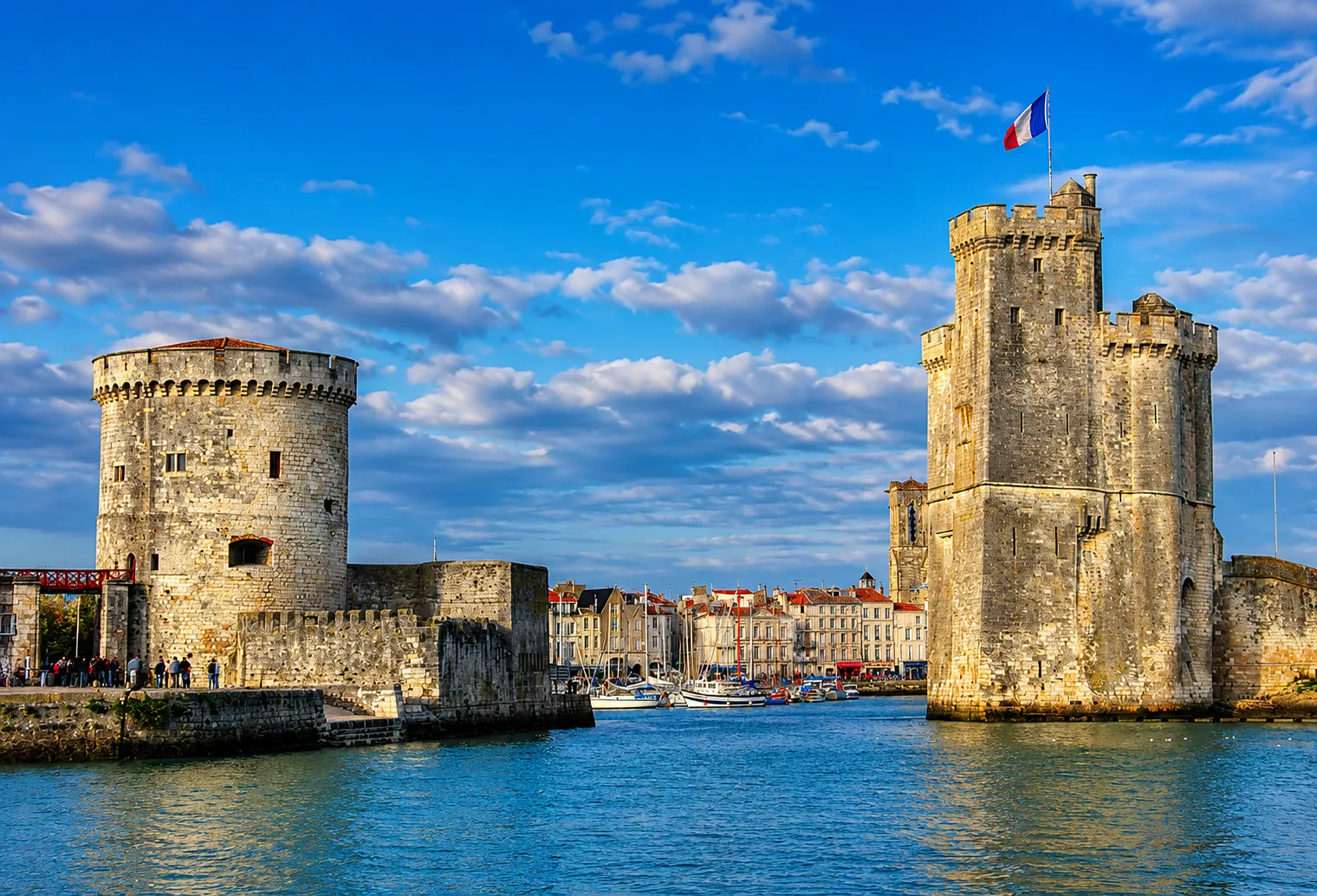
Heading further south brings you into the Charente-Maritime department, dominated by the gorgeous historic city of La Rochelle. If you are arriving here by rail, you will pull into Gare de La Rochelle, a stunning, monumental station topped with a massive 45-meter clock tower (nearly 150 feet). The station puts you within a casual 15-minute stroll of the iconic Old Port, where medieval stone towers still guard the harbor entrance.
But here is where travelers always trip up: the historic core of La Rochelle is heavily pedestrianized, packed with tight alleys, and covered in beautiful, bone-rattling cobblestones. If you have arrived hours before your holiday rental check-in time, or if you have a late train out and want to spend your final afternoon eating oysters by the waterfront, dragging giant wheelie suitcases through the crowds is pure misery. Do not waste your day babysitting your bags. Instead, make use of Radical Storage, which connects you with verified local shops, hotels, and cafes that will safely stash your luggage for a flat daily fee. It takes less than two minutes to book on your phone, lets you drop your gear at a secure counter, and leaves you completely hands-free to explore the city without breaking a sweat.
Once you’ve seen the city center, the immediate temptation is to head out to the famous nearby islands, Île de Ré and Île d’Oléron. This is where your logistical strategy needs a major rethink if you’ve rented a car. To cross the massive bridge from the mainland to Île de Ré in a vehicle during the peak summer season, you have to pay a steep €16 toll (roughly $17.50 USD). Once you actually get across the water, you will quickly realize that thousands of other drivers had the exact same idea. The island’s charming, whitewashed villages feature incredibly narrow lanes, and hunting for an empty parking spot in mid-July can easily eat up two hours of your day.
The real pro move here is to leave the bulky car behind and tackle the islands on two wheels. Île de Ré is flat as a pancake and boasts a spectacular network of over 100 km (around 62 miles) of dedicated, paved cycle paths that cut through salt marshes, vineyards, and pine forests.
Rather than wandering around the island’s main harbor town of Saint-Martin-de-Ré hoping a local shop has a spare set of wheels left, you should sort your transport in advance. By using BikesBooking.com, you can look up local providers, compare prices, and instantly reserve anything from a traditional cruiser to a high-powered e-bike or a nimble motor scooter. Having an e-bike waiting for you means you can effortlessly glide past the gridlocked summer traffic queues and park right next to the sand dunes without paying a single cent.
If you don’t feel like cycling across the high-arching 3 km bridge (about 1.8 miles) from the mainland, simply catch the local 3E regional coach run by Transports en Nouvelle-Aquitaine directly from Gare de La Rochelle. You can coordinate your connections via the regional Charente-Maritime Tourism transport portal. The bus tickets cost just a few euros, the coaches are air-conditioned, and they drop you off right in the heart of the island’s villages where your pre-booked bike awaits.
The Southern Powerhouse: Bordeaux and the Silver Coast
Next up, we are dropping down into Bordeaux, the undisputed heavyweight hub of southwest France. Whether you are arriving by air or rail, this city is the ultimate gateway to the Silver Coast—a massive, straight-as-an-arrow stretch of magnificent sandy beaches, world-class surf breaks, and dense pine forests.
If you fly into Bordeaux-Mérignac Airport (BOD), you will quickly get a taste of how the city splits its traffic. There is the main terminal building, and then there is the infamous “Billli” terminal used by low-cost airlines. Let’s be real: Billli is essentially a glorified tin shed. It is functional, but it can get incredibly hot and crowded during the summer rush.
Because Bordeaux is a major European transit point, its flight schedules can take a real beating during peak holiday seasons, with air traffic control delays or sudden cancellations throwing a massive spanner in the works. If you find yourself stuck at the gate for hours on end, do not just sit there fuming and eating overpriced sandwiches. European consumer laws are firmly on your side. You can use a dedicated recovery service like Compensair to check if your disrupted flight qualifies for a cash payout. They handle all the stressful legal back-and-forth with the airlines on a “no win, no fee” basis, which can easily win you back up to €600 (roughly $650 USD) to help fund your actual holiday instead of wasting it on a terminal floor.
To get from the airport to the city center, you have two main choices. The direct airport shuttle bus runs every 30 to 60 minutes and whisks you straight to the main train station, Gare Saint-Jean, in about 30 minutes for around €11 (about $12 USD). Alternatively, you can hop on the Tram Line A, which is dirt cheap at less than €2 (roughly $2.20 USD), but it stops everywhere and takes a sluggish 45 minutes to reach the center.
If you are arriving in Bordeaux via the high-speed TGV train from Paris, you will pull into Gare Saint-Jean, an absolute architectural masterpiece featuring a spectacular 19th-century glass roof. From here, jumping on a local regional train (TER) out to the Arcachon Bay is an absolute breeze. The train ride takes a casual 50 minutes, costs around €13 (roughly $14 USD), and drops you right by the coast.
Arcachon is fantastic for a day trip, but if your true goal is to conquer the legendary Dune of Pilat—the tallest sand dune in Europe, standing at a staggering 100 meters high (about 330 feet)—or if you want to head further south down the coast to the massive surf beaches of Biscarrosse, relying purely on local public transport will leave you stranded. The local buses that run from Arcachon station to the dune get incredibly stuck in summer traffic, so it is highly recommended to cross-reference routes on the official regional Modalis transit portal and check access updates via the official Dune du Pilat grand site portal. Trying to carry a surf board or a week’s worth of beach gear on a crowded bus is an absolute nightmare.
To tackle the vast, sun-baked expanses of the Silver Coast properly, you will want to grab a set of wheels right from Bordeaux Gare Saint-Jean. To avoid getting ripped off by local rental desks that take advantage of desperate walk-up tourists, use a trusted comparison tool like Economybookings.com. It combs through a huge variety of rental companies simultaneously, letting you filter for the best fuel policies and zero hidden costs. Locking in an affordable compact car means you can load up the boot, crank up the air conditioning when summer temperatures hit a blistering 35°C (95°F), and explore the deep pine forests completely at your own pace.
The Southern Finale: Biarritz and the Basque Country
As you slide into the ruggedly beautiful French Basque Country, the vibe changes completely. The endless pine trees of the Silver Coast give way to dramatic sea cliffs, half-timbered houses painted in deep oxblood red, and the elegant, historic surf town of Biarritz.
If you’re flying directly into the region, you’ll likely touch down at Biarritz Pays Basque Airport (BIQ). It’s a beautifully small and efficient airport, but it comes with a major trap for rail travelers. The main railway hub, Gare de Biarritz, isn’t actually in the center of town—it’s tucked away in the district of La Négresse, a solid 3 km (about 1.8 miles) inland from the famous beaches and glamorous seafront hotels. If you step out of the station expecting to see the roaring Atlantic Ocean, you’re going to be staring at a residential car park instead.
To bridge this gap without paying an absolute premium for a short taxi ride, step outside the terminal or station and look for the local Txik Txak bus network (specifically Lines 4, 5, or 38). A single ticket costs just €1.50 (roughly $1.65 USD) and gets you right into the heart of the action by the waterfront in about 15 minutes.
Because Biarritz is an upscale, highly desirable resort town, finding a place to stay that doesn’t completely drain your holiday fund can be a massive challenge during the summer peak. While everyone automatically defaults to the same main booking platforms, I highly recommend checking out Agoda to track down hidden budget gems, local guesthouses, or unexpected last-minute discounts. It’s a fantastic alternative for price-checking before you lock in a room, ensuring you save your hard-earned cash for tapas and surf lessons.
The ultimate logistical trick down here is navigating the border into Spain. The main French rail line ends at Hendaye, the final town on the French side of the border. If you want to jump over to San Sebastián for an evening of world-class pintxos, you don’t use the standard French SNCF trains. Instead, you walk right out of the main Hendaye station, turn right, and hop onto the “Topo”—a brilliant, bright little narrow-gauge train operated by the local Euskotren network. It runs every 30 minutes, takes you right into the heart of San Sebastián, and costs less than €3 (about $3.30 USD) for a one-way ticket.
But crossing borders brings up a major modern travel friction point: data roaming. Even though the EU has standard roaming rules, signal networks can get incredibly confused and drop out entirely right at the border zones between France and Spain, leaving you stranded outside a station without access to your maps or translation apps. To avoid getting locked out of your digital life, make sure you download a travel eSIM from a provider like Airalo before you head out. It gives you instant, seamless data connectivity across multiple European networks for just a few dollars, so you can track your train schedules or navigate to a hidden Basque tavern without missing a single beat.
The Golden Checklist: Nailing Your Digital Security and Safety Net
Whether you’ve just hopped off the high-speed rail at Bordeaux or you’re waiting on a delayed ferry to one of the Atlantic islands, there are two final logistical hurdles that most travellers completely forget about until it’s far too late.
The first is dealing with public Wi-Fi at these major transportation hubs. When you’re stuck at Gare de Nantes or killing time at Biarritz Airport, you’ll naturally want to log onto the free station network to check your blog feeds, pull up your digital train tickets, or log into your online banking app to verify a hire car deposit. But open, unverified public networks at transport hubs are absolute playgrounds for digital snoopers looking to intercept personal passwords and data.
Don’t leave your personal info completely exposed. Before you tap “connect” on any public network, make sure you activate a premium virtual private network like NordVPN. It instantly encrypts your entire data stream, allowing you to safely manage your money, check your itineraries, and browse securely from any crowded seaside café or bustling terminal building without a single worry.
The second hurdle is protecting yourself against unexpected bumps in the road. Navigating coastal cliffs, renting electric bikes on the islands, or taking regional transfers can occasionally result in a twisted ankle or an unexpected medical emergency. If you end up needing a quick trip to a local French clinic or a regional hospital, a basic medical consultation can quickly set you back upwards of €80 (roughly $87 USD), and emergency treatments can spiral into thousands very fast. For peace of mind regarding local updates, you can check the official travel advice statements provided by the French Ministry for Europe and Foreign Affairs.
To avoid a minor accident completely draining your travel fund, never head abroad without securing a solid travel insurance policy. I highly recommend setting up comprehensive visitor protection through VisitorsCoverage before your trip kicks off. It gives you absolute peace of mind, covering everything from sudden medical bills to lost baggage or unexpected trip interruptions, meaning you can focus entirely on enjoying the wild Atlantic coast rather than worrying about “what-ifs”.
With your travel tech secured, your digital data protected, and your transport itinerary fully mapped out from Nantes to the Basque border, you are officially ready to experience one of the most stunning coastlines in all of Europe. Just remember to take it slow, keep an eye on those regional train tables, and always choose the e-bike over a gridlocked summer car park.
Plan Your Next French Coastal Adventure
If you are mapping out more independent rail journeys, scenic drives, or island escapes across France, don’t miss our deep-dive logistical guides to these spectacular coastal destinations: