Master the scenic rail journey from Lisbon to the beautiful coastal town of Cascais, Portugal. Discover essential ticket pricing hacks, learn how to navigate the Cais do Sodré station, and skip the crowded commuter lines for a stress-free day trip.
What’s Inside This Guide
🗺️ Linha de Cascais: The Coastal Rail Route
Use this interactive map to trace the train line from Cais do Sodré in Lisbon, past the surf breaks of Carcavelos and the grand casino at Estoril, right down to the terminus in Cascais.
Is the Coastal Train to Cascais Worth the Hassle? A Guide
So, you’re sitting in Lisbon, looking out at the sun, and you fancy a day trip to Cascais. Who wouldn’t? It’s a gorgeous old fishing town packed with 19th-century villas, cracking seafood spots, and proper beaches. But then you look online, and you start hearing whispers about the train. Long queues, packed carriages, and rumors of track closures. Is the coastal train to Cascais actually worth the hassle, or are you better off booking a wheels-up option or just staying put with a cold beer? Let’s break it down over a proper chat.
Quick heads-up: Some of the links in this post are affiliate links. This means if you book a tour or secure a room through them, I earn a small commission at zero absolute extra cost to you. I only suggest things I genuinely trust, and your support keeps this site running!
The “Linha de Cascais” is the urban rail line that connects central Lisbon—departing from Cais do Sodré station—all the way to the end of the line at Cascais. On paper, it’s a total breeze: a scenic 33 to 40-minute chug along the Tejo estuary for next to no money. But right now, we need to address the massive elephant in the station.
⚠️ 2026 Travel Notice & Track Works
If you are planning this trip right now in 2026, there is a brand-new “hassle factor” you absolutely need to know about. The national rail infrastructure team has launched a massive, multi-phase modernization project on the tracks and overhead power lines between Caxias and Cascais. What does that mean for you? If you’re traveling late at night during the week (after 21:50) or over the weekends, parts of the line completely shut down, and you’ll find yourself being bundled onto replacement buses. It can easily add an extra 20 to 30 minutes to your journey. You can check the latest schedule shifts and official service disruptions directly on the official Comboios de Portugal website before you leave your hotel.
Now, if you’re traveling during peak daylight hours on a weekday, the trains run completely as normal—usually every 12 to 20 minutes. But even then, the classic hassle remains: the dreaded ticket queue at Cais do Sodré. If you show up at 10:30 AM on a blistering summer morning, you’ll find a sea of sweaty tourists queuing for the ticket machines like they’re waiting for a concert.
The clever way around this is using the “Zapping” system. You buy a reusable Navegante card for 50 cents, and instead of buying a specific paper ticket to Cascais (which costs €2.30), you load it up with cash credit at any metro station the night before. Not only do you get to bypass the entire station ticket queue and tap straight through the electronic barriers, but it also knocks the single fare down to just €2.00.
But say you just want to completely skip the station stress, or you’re traveling late at night when the 2026 track works kick in. Is it worth looking at an alternative? If you want absolute freedom to explore the Atlantic coast on your own terms without looking at a train timetable, checking out car rentals on DiscoverCars is a massive lifesaver, especially if you plan on heading out to the wild cliffs of Praia do Guincho or the Sintra hills afterward. Alternatively, if you just want to lean back and let someone else do the navigating while hitting Cascais and the surrounding sights all in one go, booking a highly-rated day tour from GetYourGuide can skip the public transport headache entirely.
But let’s assume you’re sticking to the rails for the classic coastal experience. If you do get past the ticket queues and step onto that platform, the battle isn’t quite won yet. There’s a proper strategy to choosing your carriage and your seat if you actually want to see the ocean instead of a concrete retaining wall…
The Journey: Left-Side Strategy and Greenhouse Carriages
First things first: when you walk through those barriers at Cais do Sodré, do not just scramble onto the first open seat you see. There is a golden rule on the Linha de Cascais: always sit on the left-hand side of the train facing the direction of travel. If you sit on the right, your entire 40-minute journey will consist of looking at concrete retaining walls, graffiti-covered flats, and dusty roads. Sit on the left, and as soon as the train breaks free from Lisbon’s industrial docks, you’re treated to a front-row seat of the massive Tejo estuary melting into the Atlantic Ocean.
The first ten minutes of the ride are admittedly a bit grim. You’ll rattle past container ports and old warehouses, but don’t panic—this isn’t the scenic disaster you were worried about. Around the Algés stop, the river opens up, and by the time you hit Oeiras, you’re looking at proper sandy coastlines and historic forts jutting out into the water.
If you look out the window around the Carcavelos stop, you’ll see hordes of teenagers with surfboards jumping off the train. Carcavelos is the undisputed capital of the Lisbon surf scene, boasting a massive, sweeping crescent of sand that gets hammered by excellent Atlantic swells. If you want to break up your journey and try your hand at catching a wave, it’s well worth hopping off here to join a local surf school session booked through Viator, rather than waiting until you reach the calmer, more sheltered town beaches in Cascais.
Once you roll past Carcavelos, the vibe shifts from suburban sprawl to the Portuguese Riviera. You’ll pass through Estoril, which feels incredibly grand. This place was a famous haven for exiled European royalty and WWII spies. In fact, the massive casino here inspired Ian Fleming to write Casino Royale. It’s a brilliant, slightly retro spot to base yourself if you want a classy coastal base without the hectic day-tripper crowds of Cascais itself. If that sounds like your sort of thing, it’s worth checking out the boutique guesthouses and grand old hotels around Estoril on Booking.com to see what fits your budget.
Now for a quick reality check on the trains themselves. These are commuter trains, not the Orient Express. While CP has been rolling out upgrades across 2026, many of the carriages are still older stainless-steel models. On a blistering July afternoon, they can feel a bit like a mobile greenhouse. Some have retrofitted air conditioning that blows a lovely icy gale; others rely on open hopper windows and luck.
🛡️ Safety First: Watch Out for Pickpockets
Because these trains get absolutely rammed with tourists and locals alike, they are prime hunting grounds for opportunistic pickpockets. They aren’t aggressive, but they are incredibly slick. If you’re crammed into a standing-room-only carriage, keep your daypack on your front and don’t leave your phone casually poking out of your back pocket.
Assuming you keep your wits about you, the journey flies by. Before you know it, the tracks run right alongside the sea walls, the train slows down, and you pull into the dead-end terminus of Cascais station. But once you step off the platform, how do you actually navigate the town without walking into the classic tourist traps?
Navigating Cascais: Side Alleys, Sea Monsters, and Avoiding the Traps
When you step off the train at Cascais, you are funneled through a small station and right out into a modern shopping plaza. Do yourself a massive favor: do not stop here for a bite to eat. The cafes immediately surrounding the station terminal charge a premium for lukewarm pastries and basic coffee. Instead, take a deep breath, walk five minutes down the gentle slope towards the ocean, and you’ll hit the historic old town (Centro Histórico).
The town is incredibly charming, laid out with that beautiful, traditional black-and-white wave-pattern pavement (calçada portuguesa).
🍽️ How to Avoid the Tourist Traps
If a restaurant has a bloke standing outside aggressively waving a giant laminated menu with photos of food at you, keep walking. You’ll end up paying double for frozen seafood. Instead, duck down the narrow side alleys away from the main pedestrian drag. Look for the tiny, unassuming tascas with paper tablecloths where local builders and residents are crammed in eating grilled sardines, garlic prawns, and drinking crisp, cold vinho verde out of terracotta jugs.
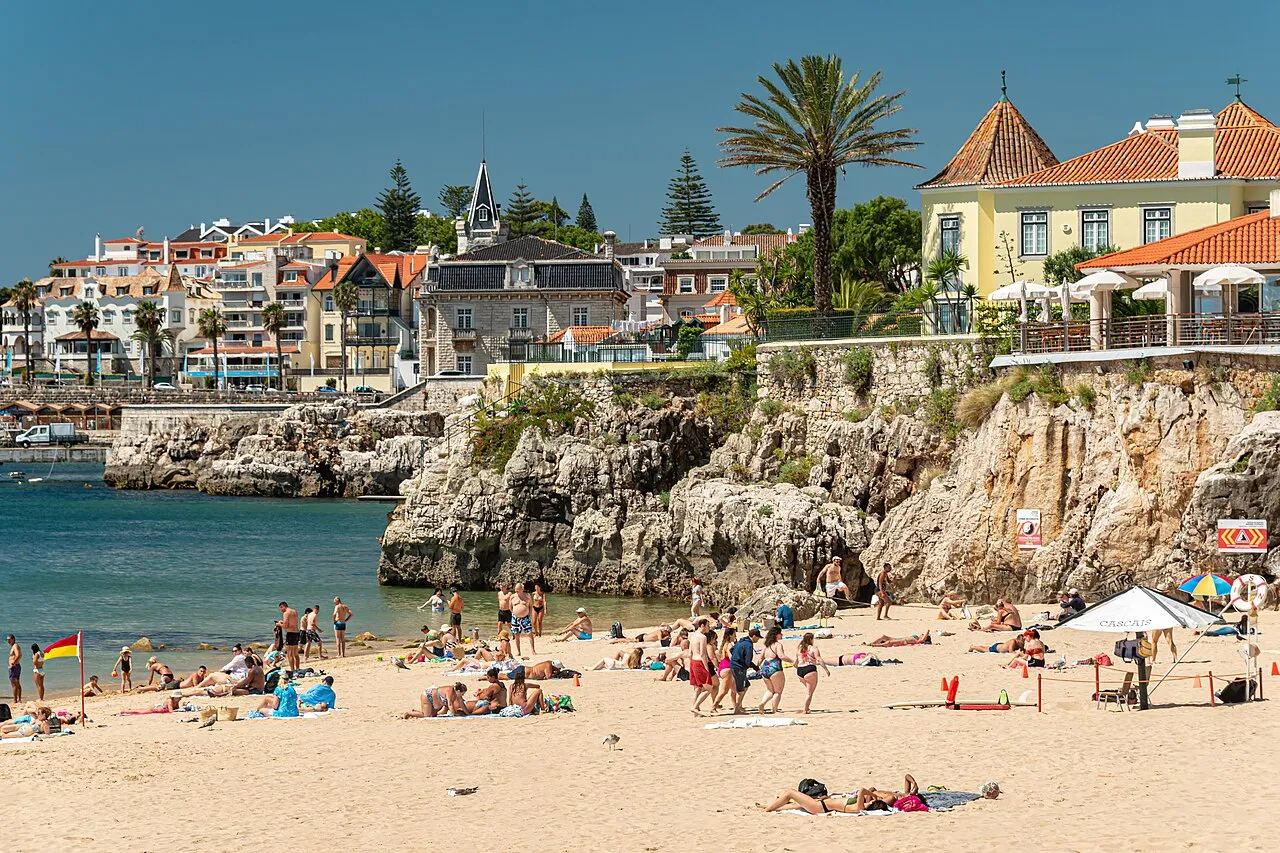
If you came for the beaches, you’ve got excellent options right on your doorstep. Praia da Rainha (the Queen’s Beach) is a stunning, postcard-perfect little cove tucked directly between the cliffs. The catch? Because it is tiny and right in the middle of town, it gets absolutely packed out by midday. If you want a bit more breathing room to stretch your legs, keep wandering past the historic fishing harbor at Praia da Ribeira. It’s a great spot to watch the local fishermen mending their traditional wicker traps, providing a proper, down-to-earth contrast to the multi-million-euro superyachts docked just a few hundred yards away at the Cascais Marina.
Speaking of the marina, walking along the paved coastal path past the historic stone citadel is the absolute best way to clear your head. Just past the fort, you’ll stumble upon the Condes de Castro Guimarães Museum—a spectacular, slightly wacky 19th-century palace built right on the edge of a rocky ocean inlet. It looks like a miniature fairy-tale castle. If you appreciate quirky gothic architecture, ancient globes, and massive pre-19th-century libraries, you can grab entry tickets ahead of time through Tiqets to make sure you lock in a time slot without standing around in another hot queue.
If you keep walking along that smooth coastal path for another twenty minutes, the manicured lawns disappear and the coast gets wild. You’ll reach the famous Boca do Inferno (Hell’s Mouth). It’s a dramatic, gaping chasm in the seaside cliffs where the wild Atlantic waves crash in with an absolute ferocious roar.
If you want an insider tip to escape the crowds on the walking path, skipping the hot pavement entirely and hopping onto a high-speed zodiac or a relaxed catamaran sailing cruise booked through GetYourGuide is a brilliant shout. Seeing the sheer scale of those sea cliffs and deep ocean caves from the water gives you a proper appreciation of just how powerful the Atlantic coast really is.
By now, you’ve probably walked a fair few miles, worked up a massive appetite, and you might be eyeing the clock. This brings us to the ultimate final verdict: when you add up the queues, the 2026 track works, and the crowds, is the train actually the best way to handle this classic day trip?
The Ultimate Verdict: Is It Actually Worth the Hassle?
Let’s cut straight to the chase. If you are heading out on a gorgeous, sunny weekday morning, the coastal train to Cascais is 100% worth it. Yes, the carriages can get a bit stuffy, and yes, you have to be clever with the “Zapping” ticket hack to avoid the dreaded queues at Cais do Sodré. But for just a couple of euros, you get a genuinely stunning coastal ride that deposits you right in the middle of town, completely bypassing the massive headache of driving.
If you’ve ever tried to park a car in central Cascais during peak season, you’ll know it’s a special kind of purgatory. The spaces are virtually non-existent, the underground multi-storeys charge an absolute fortune, and navigating the tight one-way systems while dodging distracted pedestrians is enough to ruin your holiday mood before you’ve even had a sniff of sea air. Taking the train lets you skip that entire mess.
🚗 When to Skip the Train and Drive
However, the scales tip if you’re traveling on weekends or late at night in 2026 while those massive track modernization works are active. Shuffling off a train onto a packed replacement bus with a load of tired beachgoers isn’t anyone’s idea of a fun day trip. If you’re planning to travel during those specific shutdown windows, or if you want to combine Cascais with a trip up into the mystical forests of Sintra and the wild cliffs of Cabo da Roca on the same day, public transport falls short. For that level of flexibility, grabbing a vehicle from DiscoverCars is a much better bet. It opens up the entire Atlantic highway without leaving you stranded at a temporary bus stop.
If you’re staying further out in the regional suburbs of Lisbon or arriving from another major city like Porto, you’ll first want to figure out your main rail connections into the capital. You can easily sort out your fast intercity train tickets in advance on Trip.com to make sure you land at Santa Apolónia or Oriente station with time to spare. From there, you just hop straight onto the green line on the official Metropolitano de Lisboa underground network, which takes you directly to the Cais do Sodré terminus to start your coastal run.
Ultimately, the Linha de Cascais is a classic Lisbon experience. It’s got a bit of grit, it’s unpretentious, it’s incredibly cheap, and it rewards travelers who know the inside track. Get your ticket sorted the night before, grab a window seat on the left-hand side, keep an eye on your wallet, and enjoy the ride. It’s a proper brilliant day out.
🇵🇹 More Expert Portugal Travel & Logistics Guides
- Planning a trip to the wild Atlantic outposts? Read my breakdown on how to get to Flores, Azores seamlessly.
- Heading south to the coast? Check out my insider tips on booking private boat charters in the Algarve to explore hidden sea caves.
- Crossing the northern border into Spain? Here is what you need to know about the Porto to Vigo train reliability before booking.
- Looking for a historic inland escape? Discover the charm and history of the best boutique stays in Tomar.
- Ditching the heavy daytime tourist crowds? Read my honest warning on why you shouldn’t stay in central Sintra.