What’s Inside This Guide
Honfleur Regional & Coastline Map
Use this regional view to see exactly how Honfleur fits into the spectacular northern French coastline. Zoomed out to a broader perspective, you can easily trace the massive Seine estuary, pinpoint Le Havre directly across the water, and visualize your driving routes throughout the wider Normandy and Calvados regions.
Staying in the “Jewel of the Normandy Coast”: A Guide to Honfleur
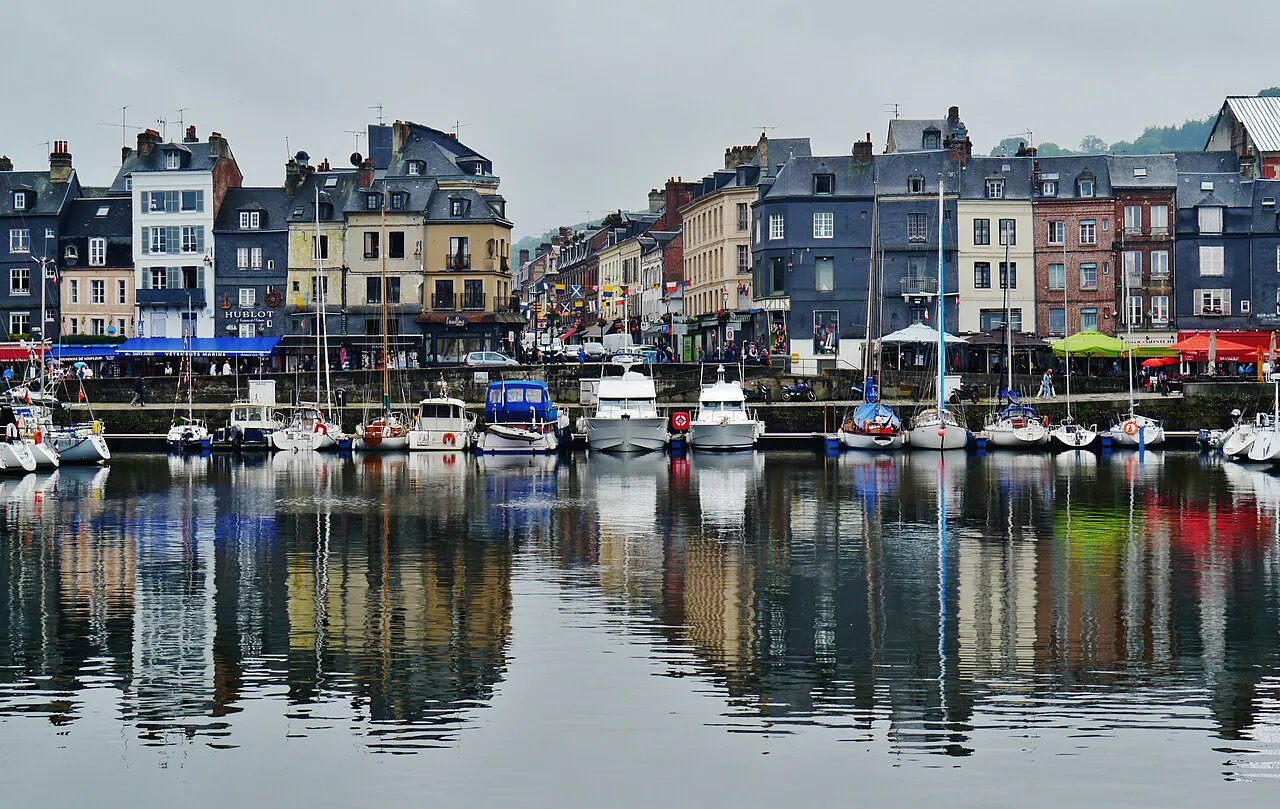
Let’s be honest for a second. If you’ve scrolled through any travel feed looking at northern France, you’ve definitely seen Honfleur. It’s that picture-perfect Norman port town with the ridiculously tall, slate-fronted houses reflecting perfectly into a harbor packed with bobbing yachts. They call it the “Jewel of the Normandy Coast,” and honestly, it earns the title. But here’s the real talk: a massive chunk of the people visiting Honfleur do it entirely wrong. They roll up on a massive tour bus at 2:00 PM, shuffle around the old harbor in a giant crowd, buy a generic postcard, and head back to Paris. They treat it like a museum checklist item rather than an actual place to experience.
Quick heads-up: Some of the links in this post are affiliate links. This means if you book a tour or secure a room through them, I earn a small commission at zero absolute extra cost to you. I only suggest things I genuinely trust, and your support keeps this site running!
The biggest decision you have to make when planning a trip here is whether to make it a quick pitstop or actually commit to staying the night. Take it from me—stay the night. When the clock strikes 5:00 PM and the day-trippers vanish back to their coaches, Honfleur completely changes. The medieval alleys quiet down, the local bistros set up their tables across the historic cobbles, and that legendary estuary light that drove Claude Monet wild starts bouncing off the historic timber walls. It goes from a crowded tourist trap to feeling like your own private medieval film set.
But staying overnight means facing the absolute boss-level puzzle of Norman travel: the logistics of getting here and finding a spot for your car. Let’s lay the groundwork. First off, you can’t get to Honfleur directly by train. If you’re coming from Paris, you’re looking at a solid 200km drive (about 124 miles) that takes around 2 hours and 20 minutes. If you aren’t keen on wrestling with French highway signs or navigating right after a long flight, grabbing a reliable private ride through Welcome Pickups to drop you right at your guest house door is a massive stress-saver.
For the road-trippers out there planning to explore the wider Calvados coastline, you’ll definitely want your own set of wheels. Comparing quotes on DiscoverCars before you land is the smartest way to dodge those brutal, last-minute desk fees. But here is my golden rule for arriving in Honfleur: do not, under any circumstances, set your sat-nav to the historic center and hope for the best. The streets around the Vieux Bassin (the iconic old port) are narrow, heavily restricted, completely paved in bone-rattling historic cobblestones, and packed with pedestrians.
Instead, use a smart “park once” strategy. Aim for the larger parking lots located just on the fringe of the old town, like the one over by the Naturospace greenhouse. It’s a beautifully flat 500-meter stroll (roughly a third of a mile) into the heart of the action. Dragging your luggage for five minutes across the pavement is a million times better than getting your mirrors clipped in a medieval alleyway. Once your car is tucked away, you can forget it even exists and check the official Normandie Tourisme site for local updates before setting off on foot. Secure a charming harbor-side spot on Booking.com early, drop your bags, and get ready to see why this town has captured hearts for centuries.
In the next section, we’re going to dive straight into the historic heart of Honfleur, exploring a church built like an upside-down pirate ship and the exact corners where Impressionist art was born.
Step Into the Postcard: The Vieux Bassin and the Church Built by Shipbuilders
Once you’ve dropped your bags, your first instinct is going to be heading straight for the water. Follow it. The Vieux Bassin is the absolute center of the Honfleur universe. Standing on the Quai Saint-Étienne and looking across at the tall, skinny houses on the Quai Sainte-Catherine, you’re looking at architecture born out of sheer medieval stubbornness. These buildings are up to seven stories high, built packed tight together because space inside the old city walls was at an absolute premium. Most of them are fronted with dark grey slate tiles to protect the ancient timber frames from the brutal, salty English Channel weather.
If you want to know the secrets behind these walls without being dragged around by a tour guide holding a neon umbrella, grabbing a self-guided smartphone audio tour from WeGoTrip is a fantastic shout. You can wander at your own pace, stop for a coffee when you feel like it, and actually learn why there’s a random, menacing stone gateway (the Lieutenancy) sitting right at the mouth of the harbor.
Just a two-minute stroll—about 150 meters (roughly 500 feet)—from the harbor edge brings you to Honfleur’s absolute crown jewel: the Église Sainte-Catherine. Now, if you’ve traveled around Europe, you’ve probably seen your fair share of massive, chilly stone cathedrals. Sainte-Catherine is completely different. It is the largest wooden church in France with a separate bell tower, and the second you step inside, you’ll see why it feels so unique. Look up at the ceiling. It looks exactly like the inside of two massive, upside-down pirate ships.
There’s a brilliant historical reason for this. After the Hundred Years’ War, the town’s stone churches were left in ruins. The locals wanted to rebuild fast, but they didn’t have the cash for expensive stone masons or heavy quarry imports. What they did have was an abundance of timber from the nearby forest and a massive workforce of highly skilled shipbuilders. So, they did what they knew best: they built a church using naval architecture techniques. It’s warm, it smells faintly of centuries-old oak and incense, and it’s completely free to walk inside.
After soaking in the maritime vibes of the church, weave your way uphill into the old lanes of the Quartier Sainte-Catherine. This is the undeniable birthplace of Impressionist art. Long before Claude Monet was painting water lilies in his garden, he was hanging out right here in Honfleur with his mentor, Eugène Boudin. They were utterly obsessed with the unpredictable estuary light where the Seine River meets the sea.
If you want to dive deeper into this artistic history, head up to the Musée Eugène Boudin. Entry tickets cost around €8 (roughly $8.50 USD) per adult, and you can easily secure your spot or bundle it with wider regional art excursions using GetYourGuide. Standing in front of a canvas painted right here 150 years ago, and then walking outside to see the exact same light bouncing off the slate rooftops, is a proper “pinch me” travel moment.
In the next section, we’re going to tackle the best part of any French trip: navigating the local markets, avoiding the tourist-trap menus on the harbor, and tasting real Norman cider.
Markets, Cider, and Avoiding the Overpriced Harbor Traps
Alright, let’s talk about everyone’s favorite subject: dinner. When you are sitting by the Vieux Bassin, watching the masts sway, it is incredibly tempting to pull up a chair at one of the flashy restaurants lining the water’s edge. Don’t do it. It’s the ultimate rookie error. Most of those places are textbook tourist traps serving up mediocre, mass-produced moules-frites (mussels and fries) that came straight out of a freezer bag, and they’ll charge you an absolute premium for the privilege.
If you want an authentic meal that won’t leave your wallet crying, walk literally two streets back from the water. Explore the narrow lanes of Rue de la Ville or Rue Haute. This is where the locals actually eat. You’ll find tiny, independent bistros where the menu is scribbled on a chalkboard and changes daily based on whatever fish was hauled off the boats that morning. A fantastic three-course menu in these hidden spots will usually run you around €28 (roughly $30 USD) per person, offering double the quality of the harbor fronts for a fraction of the cost.
If you happen to be in town on a Saturday morning, you are in for an absolute treat. The weekly Honfleur market takes over the streets surrounding the wooden church, and it is a complete sensory overload. The air is thick with the aroma of spit-roast chickens, fresh sea air, and massive wheels of unpasteurized Norman cheese. You’ve got to try the big three: Camembert, Livarot, and Pont-l’Évêque.
Here is a quick pro-tip for market day: the crowds get absolutely packed by 11:00 AM. If you’ve already checked out of your hotel or guest house but want to graze your way through the food stalls without knocking people over with your suitcases, do yourself a massive favor. Stash your heavy bags safely at a verified local shop using Radical Storage so you can navigate the narrow market aisles completely hands-free.
While you are exploring, you’ll quickly notice that wine takes a back seat in this corner of France. Normandy is apple country, which means you are here to drink cider, Pommeau, and Calvados. Artisanal cider here is serious business, and a crisp, refreshing bottle of local Cidre Bouché will only cost you about €5 (around $5.30 USD) at the market stalls. Look out for Brut if you like it dry and crisp, or Doux if you prefer something sweeter to pair with a fresh crepe.
If you want to take your apple education to the next level and learn how they distill these local fruits into fiery, smooth apple brandies that age for decades, it’s worth doing a proper tasting. To avoid the guesswork and get a guided journey through the historic cellars of the region, you can lock in a regional tasting excursion via Viator to visit local orchards and sample the finest Calvados drops directly from the source. You can also check out the official Office de Tourisme de Honfleur for the exact seasonal times of the traditional fish markets down by the piers.
In the next section, we’re going to lace up our walking shoes and head uphill to escape the crowds, finding the absolute best panoramic viewpoint over the massive Normandy Bridge before looking at where to book your stay.
Escaping the Crowds: The Hilltop Chapel and Where to Lay Your Head
When the afternoon crowds in the old harbor start getting a bit too intense, there is a secret escape hatch right in plain sight. Lace up your walking shoes and head up the Chemin de Grâce. It is a bit of a steep, calf-burning climb—about a 1.5km hike (around 1 mile) uphill from the harbor edge—but the reward at the top is completely worth the sweat. You’ll leave the chatter of the tourist crowds behind and find yourself walking along a peaceful, tree-lined ridge known as the Côte de Grâce.
Tucked away under a canopy of ancient, sprawling trees sits the Notre-Dame de Grâce chapel. Built in the early 17th century, this little stone chapel is a beautiful testament to Honfleur’s deep maritime soul. Step inside and you’ll see walls lined with paintings, plaques, and incredibly detailed model ships hanging directly from the ceiling. For centuries, Norman sailors and their families came here to pray for safe passage across the treacherous Atlantic, or to leave these models as “ex-voto” tokens of gratitude for surviving terrifying storms at sea. It’s quiet, incredibly atmospheric, and completely free to visit.
Just a short, flat stroll further down the path brings you to the Mont-Joli viewpoint, and this is where you get the ultimate layout of the land. From this vantage point, the entire Seine estuary opens up right in front of you. You can look straight down onto the patchwork of Honfleur’s slate-grey roofs, and then cast your eyes out toward the open sea to marvel at the massive Normandy Bridge. It is an absolute engineering masterpiece, stretching for over 2.1km (roughly 1.3 miles) across the river to connect Honfleur to the port of Le Havre. Standing up here as the sun starts to dip, watching massive cargo ships slide beneath the bridge’s elegant cable stays, is spectacular.
Once you’ve soaked in the views and headed back down the hill, it’s time to tackle the fun part: picking exactly where you’re going to crash for the night. Because Honfleur is packed with character, your accommodation should be too. If you want to stay right in the thick of it, look for a boutique bed-and-breakfast tucked inside a restored, timber-framed townhome. Waking up, throwing open the wooden shutters, and smelling fresh croissants from the bakery downstairs is unmatched. You can browse the absolute best central spots on Booking.com to find a place that puts you steps away from the evening harbor lights.
However, if you’re traveling during the peak summer months and finding that prices are looking a bit steep, don’t throw in the towel just yet. It is always worth cross-referencing your dates on Agoda to see if you can snag a flash deal or a budget-friendly room rate that keeps your trip affordable without forcing you to stay miles out of town. Expect a decent mid-range double room in the center to run you around €120 to €180 per night (roughly $130 to $195 USD).
For those traveling as a family, planning a longer stay, or hitting the Norman coast with a group of friends, the central hotel rooms can feel a bit cramped. In that case, look slightly outside the town borders. The surrounding Calvados countryside is dotted with gorgeous, traditional stone cottages and converted barns. Booking a full vacation rental through Vrbo gives you the ultimate flexibility—think your own private garden to sit out in with a bottle of local cider, a full kitchen to cook up your Saturday market finds, and tons of space to stretch out after a long day of exploring.
In the final section, we’re going to wrap everything up into a quick, no-nonsense logistical checklist so you can execute your Honfleur trip with absolute confidence.
Your Ultimate Honfleur Logistical Checklist
To wrap things up and make sure your trip goes off without a single hitch, let’s run through a quick, no-nonsense logistical checklist. This is the stuff that saves you time, money, and a massive headache when you’re actually on the ground in Normandy.
- The Best Time to Roll Up: While summer brings gorgeous long evenings, July and August are absolutely packed. If you want to actually breathe while walking the historic alleys, aim for May, June, or September. The weather is still brilliant, and you won’t have to fight three hundred people for a harbor-side photo.
- Sorting Your Data: Don’t get lazy and just turn on your home network’s data roaming, because those daily fees will sting you hard. Instead, get your connectivity sorted before you even clear passport control. Popping a digital eSIM from Saily onto your phone gives you instant, cheap local data the second you land, meaning you can look up your parking lot coordinates without relying on sketchy public Wi-Fi.
- Packing for Channel Weather: Normandy is beautifully green for a reason—it rains. Even if you’re visiting in mid-July when summer temperatures average a comfortable 22°C (around 72°F), a sudden coastal breeze can make it feel much cooler. Always pack a lightweight waterproof jacket and a warm layer. Before you head out for the day, double-check the local radar on Météo-France so you don’t get caught out.
- Dealing with Transit Disasters: If you are flying across the Atlantic or hopping over from the UK to start your French road trip, there is always a chance the airlines will mess up your schedule. If your flight gets delayed into Paris or cancelled entirely, don’t just sit at the gate fuming. You can use AirHelp to instantly check if you’re eligible for a cash payout under European consumer laws, which can reach up to €600 (roughly $650 USD) per person on a “no win, no fee” basis.
- Cash vs. Card: Virtually every bistro, market seller, and boutique hotel in Honfleur takes contactless card payments. However, it is always a smart move to keep a few small coins on you. Having €5 or €10 (roughly $5.30 to $10.60 USD) in loose cash is a lifesaver for grabbing a quick morning espresso or buying a single bottle of artisanal cider directly from an older farmer at the Saturday market.
With your parking sorted, your bags stashed, your data active, and a glass of crisp Calvados cider in your hand, you are completely set to experience Honfleur the right way. Enjoy the evening quiet, stay the night, and let this incredible coastal jewel show you its true colors.
🇫🇷 More Expert France Travel & Logistics Guides
- If you love dramatic coastlines but want to swap the mainland harbor for a rugged, wind-swept island escape, look into navigating the logistics of taking the ferry to Belle-Île-en-Mer off the coast of Brittany.
- Alternatively, for a wild, pristine tidal experience closer to home in Normandy, check out our comprehensive guide to arranging your Chausey Islands day trip ferry routes.