Discover the ultimate route to uncovering the spectacular, secluded secret beaches of northern Galicia, Spain. Avoid the heavy crowds and master expert tips on tidal timings, rugged access trails, and hidden cliffside paths to explore this untamed coastline safely.
Inside This Guide
- 1. Getting Your Wheels & The Road to Cedeira
- 2. Pristine Curves: Praia de Vilarrube
- 3. Towering Heights: Serra da Capelada & Vixía Herbeira
- 4. Hidden Haven: San Andrés de Teixido & Praia de Fornos
- 5. Cliffs of Loiba: The Best Bench in the World
- 6. The Edge of Iberia: Estaca de Bares & Praia de Esteiro
- 7. Emerald Paradise: Praia de Xilloi & Viveiro Town
- 8. The Grand Finale: The Holy Waters of As Catedrais
🗺️ Rías Altas Road-Trip Route Map
Use this live interactive map to navigate the rugged Northern Galician coastline. You can pinch to zoom, drag to pan across the coastal highways, and explore the exact areas surrounding our route from Cedeira up to Ribadeo.
Right, let’s be entirely honest for a minute. If your idea of a perfect beach holiday involves fighting three hundred people for a square inch of sand while an overpriced speaker blasts loud music, you are looking at the wrong corner of Spain. Northern Galicia—specifically the rugged, wind-swept stretch known as the Rías Altas—is an entirely different beast. We are talking about massive, towering emerald cliffs, wild Atlantic waves crashing into hidden coves, and beaches so empty you’ll swear you stumbled onto an undiscovered continent. It is absolutely brilliant, completely untamed, and one of the best road trips you will ever take.
Quick heads-up: Some of the links in this post are affiliate links. This means if you book a tour or secure a room through them, I earn a small commission at zero absolute extra cost to you. I only suggest things I genuinely trust, and your support keeps this site running!
1. Getting Your Wheels & The Road to Cedeira
Now, before we pack the bags, there is one massive catch you need to know about. You cannot do this trip using public transport. If you try to rely on regional buses or trains to find these hidden coastal gems, you are going to spend your holiday stuck at a sleepy rural bus stop miles away from the water, staring at a timetable that hasn’t changed in a decade. To truly explore the secret coves tucked away between Ferrol and Ribadeo, you absolutely need your own set of wheels. The smartest move is to fly into Santiago de Compostela or A Coruña, grab a rental vehicle right at the airport terminal, and hit the open road. I always recommend using a solid aggregator like DiscoverCars to sort this out before you land. It lets you compare local providers side-by-side so you can lock in a reliable vehicle without getting completely stung by massive hidden fees or forced insurance upgrades when you get to the rental desk.
Once you have your keys, it is time to head north toward our very first base camp: the historic coastal town of Cedeira. Driving through this part of Spain feels less like standard European highways and more like navigating a prehistoric landscape where the mountains literally crash directly into the ocean. The roads are beautifully paved but incredibly twisty, winding through dense eucalyptus forests before opening up to jaw-dropping views of the Atlantic.
2. Pristine Curves: Praia de Vilarrube
As you arrive in the region, the first hidden treasure to hunt down is Praia de Vilarrube. Tucked safely inside the sheltered estuary of the Ría de Cedeira, this beach is an absolute masterclass in natural geometry. It features a massive, sweeping crescent of pristine, powdery white sand framed by calm, turquoise waters that look more like the Caribbean than northern Spain. Because it is protected from the brutal open-ocean swells, it is a brilliant spot for a relaxing dip without getting battered by the surf. After a day spent exploring the coastal trails, you will want a comfortable place to drop your bags and grab a cold drink. The town of Cedeira itself is packed with traditional stone houses and incredible seafood taverns. I usually hop onto Booking.com to track down a locally run guesthouse or traditional apartment right by the harbor, which gives you the perfect base to enjoy fresh octopus and local Albariño wine after the sun goes down.
To make sure you don’t get lost on the rural dirt tracks leading down to the coastal trailheads, it is always a smart idea to double-check your routes with the official maps provided by Turismo de Galicia, as they keep tabs on seasonal parking restrictions and trail safety. But Vilarrube is just the warm-up act. Just a short drive further north lies a stretch of coastline where the cliffs reach dizzying heights, home to a tiny sanctuary steeped in local legend and a beach that feels like the literal edge of the world.
3. Towering Heights: Serra da Capelada & Vixía Herbeira
Leave Cedeira behind and prepare your clutch foot, because you are about to climb straight up into the Serra da Capelada. This mountain ridge holds the distinction of being home to some of the highest cliffs in continental Europe, peaking at a spot called Vixía Herbeira. At over 600 metres above the crashing Atlantic, standing at the edge will absolutely make your stomach drop. On a clear day, the views are nothing short of spiritual. On a misty day—which happens a lot up here—it feels like you’re driving through a moody, atmospheric ghost story.
When navigating these high ridge roads, you need to watch out for the true locals. And by locals, I don’t mean Galician farmers; I mean the herds of semi-wild horses and shaggy mountain cows that treat the tarmac like their personal living room. They have absolutely zero fear of your car, and they will happily stand right in the middle of a blind bend chewing grass. Take it steady, keep your eyes peeled, and enjoy the slow pace. If you haven’t locked in your transport yet and want to compare rates across different regional suppliers to make sure you’re getting a vehicle sturdy enough for these steep mountain inclines, it’s worth checking out Economybookings.com. They are brilliant for sniffing out budget-friendly, robust sets of wheels that won’t struggle on a 15% gradient.
4. Hidden Haven: San Andrés de Teixido & Praia de Fornos
As you wind back down towards sea level, you’ll pass through the tiny, isolated hamlet of San Andrés de Teixido. Local lore says that everyone must visit San Andrés at least once in their life, and if you don’t make it while you’re alive, you’ll have to crawl there as a reptile after you die. To be safe, pull over, buy a traditional breadcrumb amulet from the local ladies, and enjoy the absolute peace of the valley.
From San Andrés, the road snakes down toward the rugged cape of Cabo Ortegal and the quiet fishing town of Cariño. This is where you will find your next hidden gem: Praia de Fornos. Tucked away on the sheltered side of the peninsula, Fornos is a dramatic contrast to the wild cliffs you just crossed. It’s a stunning expanse of fine white sand backed by deep green pine trees, completely shielded from the brutal open-ocean winds. The water here is incredibly clear and calm, making it a favorite for local families who want to escape the rougher Atlantic surf. If you want to experience this crazy coastline from a completely different perspective, you can sometimes find brilliant local rib-boat excursions or guided geological sea-kayaking treks listed on GetYourGuide. Seeing those massive 600-metre cliffs looming over you from the water level is something you won’t forget anytime soon.
The golden rule for exploring this specific stretch of the Rías Altas is to never let the weather catch you off guard. Galicia is beautifully green for a reason—it gets plenty of liquid sunshine, and the Atlantic fog can roll in over the mountains in a matter of minutes. Before you plan a trek down any steep, unmarked goat tracks to reach a secluded cove, always fire up MeteoGalicia on your phone. It is the official, highly accurate regional weather service that gives you hyper-local wind, rain, and fog updates that general global weather apps completely miss.
Once you’ve dipped your toes in the calm waters of Fornos, it’s time to push further east across the massive, sweeping estuary of Ortigueira. Our next stop takes us to a rugged headland famous for a solitary wooden bench, an impossibly narrow sea bridge, and a beach hidden so deeply within the cliffs that most tourists drive right past it without ever knowing it’s there.
5. Cliffs of Loiba: The Best Bench in the World
Next up on the map is a spot that became internet-famous a few years back, but it is still absolutely worth your time. I’m talking about the cliffs of Loiba. This is where someone bolted a simple wooden bench to the edge of a cliff, scribbled “The Best Bank in the World” on the back (a bit of a lost-in-translation moment meaning “The Best Bench in the World”), and created an overnight sensation. Yes, you might have to queue for a few minutes to get your photo on it during a busy summer weekend, but the view looking down at the jagged rock formations rising out of the foam is spectacular.
But we aren’t here just for a photo on a bench. If you look closely over the edge, you will spy Praia de Picón and Praia de Fábrega. These beaches are reached by incredibly steep, zig-zagging wooden steps built directly into the cliffside. On a rough day, the Atlantic completely swallows them up, but at low tide, they open up into dramatic, desolate stretches of dark sand surrounded by twisted rock arches. Driving these tight, single-track lanes between the cliffs requires a car with decent ground clearance and tight brakes. If you are planning a longer journey across the northern coast and want a massive choice of vehicles backed by decades of reliable service, booking through an international broker like AutoEurope is a very smart shout. It ensures you won’t end up with a tiny, underpowered hatchback that groans every time you hit a 12% coastal incline!
To avoid getting stuck on a private farming track or copping a nasty fine for parking in the wrong field near the cliffs, always take a quick look at the official Concello de Ortigueira website before you head out. They post updated seasonal driving routes and show you exactly where the official municipal parking areas are located.
6. The Edge of Iberia: Estaca de Bares & Praia de Esteiro
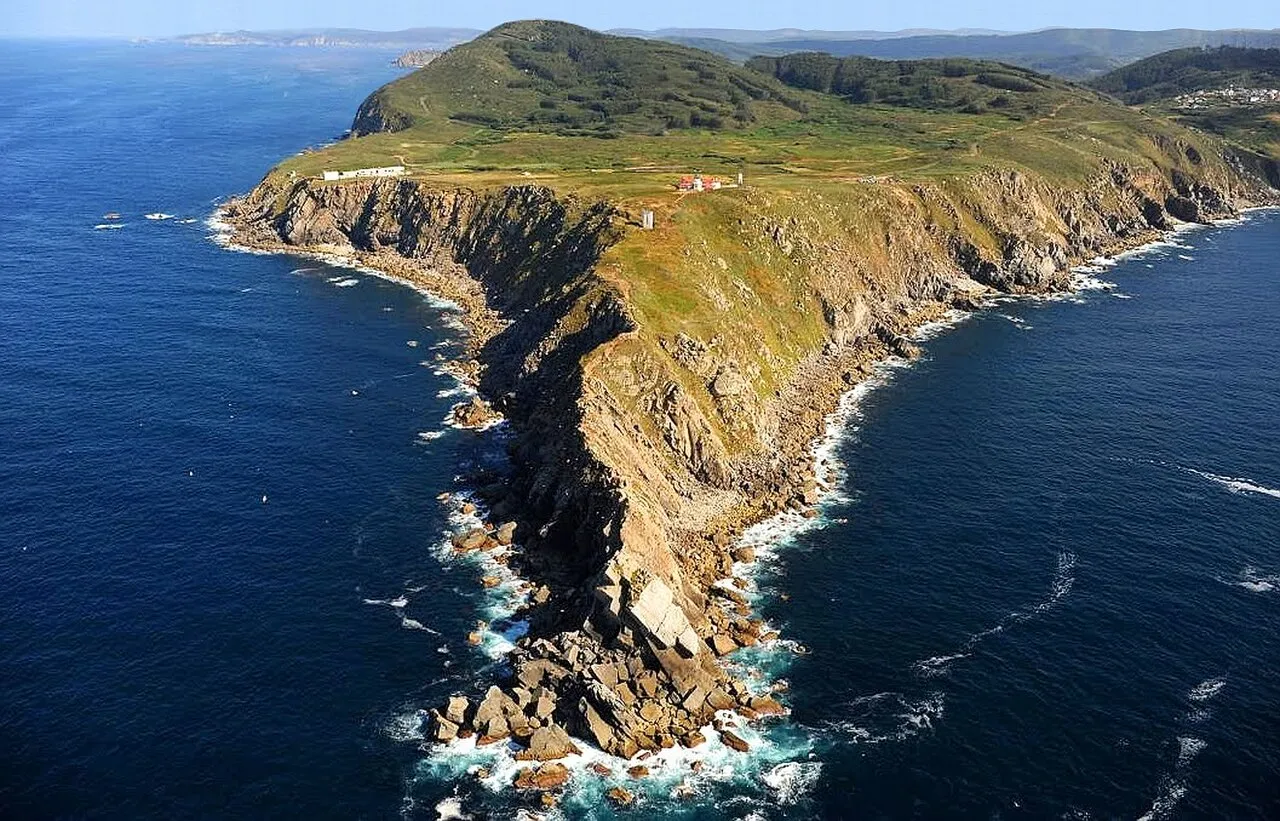
From Loiba, keep pushing east until the road literally runs out. You will hit Estaca de Bares, which is the absolute northernmost point of the entire Iberian Peninsula. This is the exact geographical boundary where the open Atlantic Ocean collides with the Bay of Biscay. Stand by the old lighthouse, and you can watch the two currents smashing into each other like a couple of heavyweights in the ring.
Right around the corner from this headland is Praia de Esteiro. This place is an absolute cracker of a beach. It is a wide, sandy spit where a freshwater river winds its way out to the sea, creating a massive, calm lagoon on one side and a roaring Atlantic surf break on the other. It’s an incredible spot to watch local surfers catch some massive waves. If you fancy doing a proper deep-dive into the wild geography of this area without accidentally wandering onto private land or getting trapped by a rising tide on an isolated beach, it’s well worth booking a local coastal trek or nature excursion. I always use Viator to scout out these kinds of guided outdoor activities, as they connect you directly with local experts who know every secret cave and hidden path along the headlands.
Once you’ve cleared the dramatic cliffs of Bares, you will drop down into the deep, sheltered emerald waters of the Ría de Viveiro. Here, hidden completely out of sight behind a massive green headland, lies a beach shaped like a perfect crescent moon that looks like it belongs in a high-end travel magazine. But to get down to it, you’ll have to navigate a maze of narrow residential streets that most tourists completely miss.
7. Emerald Paradise: Praia de Xilloi & Viveiro Town
As you slide down into the Ría de Viveiro, the landscape changes slightly. The brutal, intimidating cliffs of the open Atlantic give way to a softer, deeply forested estuary where the water turns a brilliant emerald green. This brings us right to one of the most perfectly formed hidden beaches in the region: Praia de Xilloi. Tucked behind a massive headland, Xilloi looks like a perfect crescent moon carved out of the coast. The sand here is incredibly fine and powdery, and because it faces away from the open sea, the water is as flat as a bowling green. It’s an absolute paradise if you want a proper swim without fearing for your life against the Atlantic currents.
To find Xilloi, you have to navigate a labyrinth of narrow, winding residential lanes and old farming tracks. If your phone loses its signal out here in the rural Galician valleys, you are going to find yourself reversing down a one-way dirt track with an angry tractor driver staring you down. To avoid that exact headache, I always recommend sorting out an eSIM before you leave home. Grabbing a local data profile from a trusted global provider like Airalo is a total game-changer for a road trip like this. It gives you an instant, rock-solid internet connection the second you cross into the region, meaning your digital maps won’t suddenly freeze right when you need to spot a hidden turn-off.
After soaking up the peace at Xilloi, you will want to head into the bustling historic town of Viveiro itself. It’s a fantastic place to base yourself for a night or two, complete with old medieval stone gates, lively squares, and plenty of taverns serving up massive plates of local empanada and fresh razor clams. When it comes to booking a place to crash, you don’t need to spend a fortune on generic hotels. I love hopping onto Agoda to scout out discounted rates on local holiday homes, traditional stone cottages, or budget-friendly apartments right near the historic centre. It’s a brilliant way to save a bit of cash that you can better spend on a massive seafood dinner down by the harbor later that evening.
Before you head out to explore the surrounding coves the next morning, it is well worth spending five minutes checking the official Concello de Viveiro website. They keep a completely updated, accurate list of local beach facilities, active lifeguard schedules, and water quality reports, which is brilliant if you’re planning to explore some of the more remote, rocky inlets nearby.
From Viveiro, the coastal highway takes you further east past the industrial port of Burela and into the sweeping sands of Foz. The coast starts to open up here, flattening out into massive, wide-open strands that feel incredibly expansive. But we are nearing the grand finale of this northern road trip. Just a short drive ahead lies the border with Asturias and a beach so utterly famous and unique that the local government actually has to limit the number of people who can step foot on it each day. You cannot just turn up and hope for the best; you need a proper strategy to see it.
8. The Grand Finale: The Holy Waters of As Catedrais
Right, we have finally made it to the absolute heavyweight champion of the Galician coastline: Praia de As Catedrais (the Beach of the Cathedrals), located just a few miles outside the border town of Ribadeo. This isn’t just a standard stretch of sand; it’s a massive, natural playground of soaring stone arches, deep dark caves, and towering flying buttresses carved out of the slate by thousands of years of relentless Atlantic waves. When you walk between these giant rock formations at the right time, it genuinely feels like you’re wandering through the nave of a massive, roofless gothic cathedral. It is completely jaw-dropping, but if you don’t plan this stop with military precision, it will turn into a massive disappointment.
Here is the golden rule for As Catedrais: you absolutely must visit at low tide. If you turn up at high tide, the entire beach is completely swallowed by the ocean, and you’ll be left standing on a cliffside viewing platform looking at a load of churning water, feeling like a right muppet. Check the local tide tables online before you set off and aim to arrive roughly an hour before the absolute lowest point. This gives you plenty of time to drop down onto the sand and explore the deep sea caves safely before the incoming Atlantic tide starts chasing you back toward the cliffs.
Because this place is so famous, the local government has stepped in to stop it from getting totally ruined by overcrowding. If you are doing this road trip during the peak summer months or over the Easter holidays, you cannot just rock up and park your car. The regional authorities limit daily foot traffic, and you legally need to secure a free entry pass in advance. Don’t fall for sketchy third-party websites trying to charge you a premium for these tickets; get your pass directly from the official Xunta de Galicia booking portal. It costs absolutely nothing, takes two minutes to sort out on your phone, and keeps you completely on the right side of the law.
After you’ve finished exploring the arches and got plenty of sand between your toes, it’s time to wind down the road trip in the beautiful town of Ribadeo itself. Sitting right on the edge of the sweeping estuary that divides Galicia from Asturias, it’s a fantastic spot to celebrate the end of your driving adventure. If you’re traveling with a group of mates or family and want to celebrate in style, skip the cramped town-centre hotel rooms. Instead, look up a massive traditional coastal villa or a house with a proper garden and sea views on Vrbo. Having your own kitchen to cook up some local market finds and a private deck to watch the fishing boats roll into the estuary is the absolute perfect way to toast the end of the trip.
When the time comes to finally turn the car around and head back toward the airport at Santiago or A Coruña to catch your flight home, there is one last practical hurdle to clear. If you have a late evening flight but have to check out of your holiday home in the morning, the last thing you want is to leave your rental car stuffed to the brim with expensive camera gear, tech kits, and suitcases parked on a busy city street while you grab a final lunch. To dodge that stress entirely, look up a secure local locker or verified shop spot using Radical Storage. It lets you drop your heavy bags off in a verified local business for a few hours for a tiny flat fee, meaning you can wander around the historic city squares completely hands-free until it’s time to drive to the terminal.
Northern Galicia is wild, unpredictable, and completely unforgettable. It requires a bit of extra planning, a sharp eye on the weather, and a sturdy pair of driving shoes, but the reward is a slice of untouched Europe that most travelers will never even see. Pack your bags, lock in your car, and get ready for an absolute classic of an adventure.
🇪🇸 More Expert Spain Travel & Logistics Guides
- Weighing up transit choices down south? See my comprehensive Andalusia train vs car guide.
- Driving up north? Be fully prepared for navigating Asturias’ narrow coastal roads.
- Island hopping in the Med? Master your connections with my guide to Balearic transport hubs.
- Visiting a picturesque northern fishing village? Read my complete Cudillero travel guide.
- Heading to the Balearics car-free? Learn how to navigate Menorca beaches without a car.
- Visiting Spain’s Atlantic paradise islands? Lock in your Cies Islands ferry booking logistics.
- Planning a Pyrenees climbing adventure? Check out the best Alquezar climbing accommodation.
- Looking for historic, high-end stays? Use my expert guide to booking Spanish Parador hotels.